
The Ground Beneath This Industry Is Moving. Here Is What You Need to See
New Zealand’s Crematorium Infrastructure Is Entering a Major Transition
Most of the people running cremation services in New Zealand right now did not get into this work for the business of it. They got into it because someone has to do it with care. Because families in their worst moments deserve to be looked after properly. That has not changed.
What has changed is everything around it. The families walking through the door. The regulatory framework quietly building in the background. The economics of the equipment behind the business. If you are running a funeral home, a crematorium, a cemetery trust, or any service that provides cremation in New Zealand, the next few years will ask something of you that the last few did not.
Here is what is actually moving, and why it matters.
Families are showing up differently
Around 75% of New Zealanders now choose cremation. That number is still climbing, and it will not reverse. But more interesting than the number is the shift in what families bring with them when they arrive. They have done their research. They know what things cost. And increasingly, they are asking questions that would not have come up ten years ago. Questions about environmental impact. About how the process works. About what kind of equipment is being used.
That last one is newer than most operators realise. For a growing number of families, it genuinely matters. It is not a deal-breaker today. In five years it will be a much more common conversation.
The consolidators are paying attention
Private equity and large funeral groups have been moving through New Zealand and Australia with quiet patience, acquiring independent operators and rolling them into centralised structures. The pitch is always the same: cremation is scalable, efficient to run at volume, and the current generation of owner-operators is approaching retirement without obvious successors.
Independent funeral homes are the most visible target, but the pressure is broader than that. Council and trust-operated crematoria are being held to sharper accountability around infrastructure fitness and compliance. Cemetery operators expanding into cremation services are entering a market that is being restructured around them in real time. The organisations that hold their ground will be the ones that can point to equipment that is modern, compliant, and built for where the sector is going rather than where it has been.
The regulation
This is the part of the picture that most operators have not yet fully mapped, and it is the most consequential.
New Zealand's National Environmental Standard for Greenhouse Gas Emissions from Industrial Process Heat came into force in July 2023. It applies to fossil fuel combustion devices, furnaces included. The Zero Carbon Act commits this country to phasing out fossil gas from industrial use by 2050. The Commission’s Demonstration Pathway makes it clear: transitioning process heat away from coal and gas toward electric alternatives is critical for achieving net‑zero by 2050.
A gas cremator installed today is expected to operate for twenty to twenty-five years. That takes you to somewhere between 2045 and 2050. You do not have to squint very hard to see the problem.
To be clear about one thing: switching to electric does not remove all consent obligations. Discharge to air consents are still required because the cremation process itself produces particulates regardless of the energy source. What falls away is everything wrapped around fossil fuel combustion. The carbon pricing exposure. The emissions plan obligations. The tightening consent environment that is only going to get tighter. That is a meaningful difference for anyone making a long-term infrastructure decision right now.
For a council‑run crematorium, these two pressures look like this:
Carbon pricing exposure
Council‑operated gas cremators face rising operating costs because gas retailers must buy NZ ETS units, and those carbon prices increase over time. This means every year the cost of running a fossil‑fuel cremator goes up, regardless of efficiency improvements.
Emissions plan obligations
Councils must show that new or renewed infrastructure aligns with national emissions‑reduction plans. Investing in new fossil‑fuel cremation equipment risks breaching those obligations and locking in high‑emission assets that contradict mandated decarbonisation pathways.
The cost curve that changes everything
There is a financial argument for electric that rarely gets explained clearly, so here it is.
Gas and diesel cremation is linear. Every cremation consumes fuel, so costs scale directly with volume. Run more cremations, spend more on gas. There is no structural reward for being busy. Electric works differently. The capital investment is higher upfront, but the marginal cost of each cremation is low and stays low. As volume increases, the cost per cremation trends downward. The infrastructure earns its keep more efficiently the more it is used.
New Zealand's population aged 70 and over is growing. More families across more communities will need these services in the years ahead. For a gas operator, that means rising fuel costs. For an electric operator, it means steadily improving operating economics. The curve bends in your favour rather than against you.
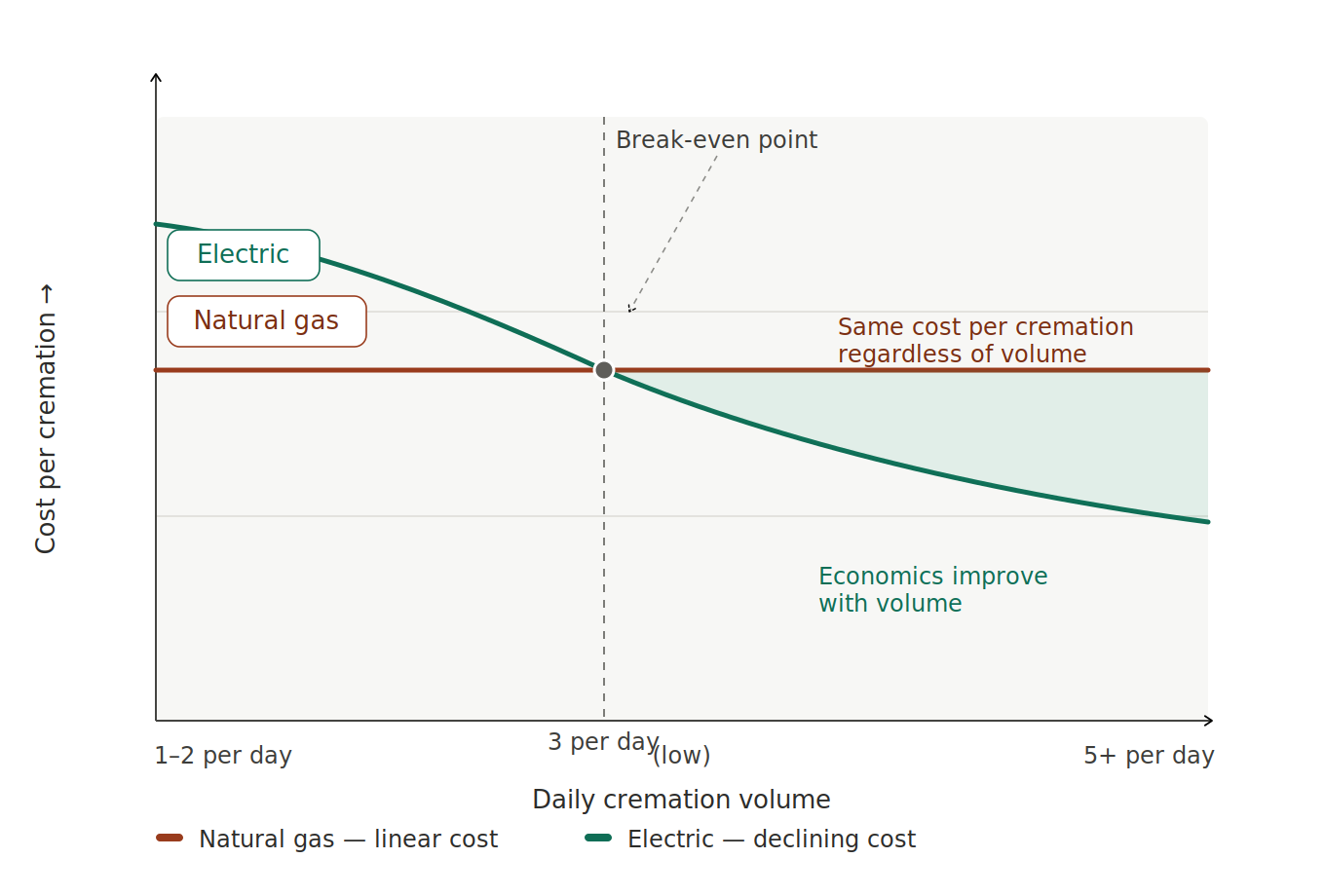
Graph is for educational purposes only. Exact breakeven point may vary depending on various factors
What this actually means for you
Whether you are a funeral-home owner weighing up your cremator, a crematorium owner watching your cremation infrastructure age, a cemetery trust considering a capital project, or a board trying to make a decision that will look sensible in twenty years, the question underneath all of this is the same.
The decision you make on equipment is not just a procurement call. It is a bet on what the operating environment looks like across the full lifespan of whatever you install. Gas infrastructure bought today will still be running when New Zealand's fossil fuel phase-out timeline arrives. Electric infrastructure will not carry that risk.
The operators having this conversation now are not chasing novelty. They are the ones who looked at the policy direction, ran the numbers, and decided they would rather be ahead of this than caught by it.
About Bidcom Technologies
Bidcom Technologies is a New Zealand manufacturer developing the KPBT IV, an electric cremation system built for the demands of modern crematorium operation. If you are thinking about your next cremation system now, let's talk.